
fire and safety training Perth WA
If the only practice your team gets is a 20-minute video, what happens when smoke, noise and a blocked exit turn fire and safety theory into a real decision?
practical workplace fire safety training
Online-only fire and safety modules look efficient on a training register. The problem is what they leave out. A worker who has only ever clicked through slides has never felt the weight of an extinguisher, never raised their voice over an alarm to direct a colleague, never walked an evacuation route in the dark with smoke at head height. The first time any of that happens should not be the first time it counts.
Real training accepts that people behave differently under pressure. Hands tremble. Voices drop. The brain reaches for the most-rehearsed action, which is why the rehearsal has to be the right one. A workplace where wardens have practised giving the evacuate order out loud, where staff have actually held an extinguisher with the pin pulled, and where the assembly point has been walked rather than just printed on a diagram, behaves very differently when the alarm sounds. The tick on the register is not the training. The practice is.
Key takeaways for WA workplaces:
- KI Training & Assessing has delivered safety training to over 10,243 students, with 258+ Google reviews and a 98% satisfaction record across WA workplaces.
- Fire safety training has to rehearse the first minutes of an incident, not just play a video, so wardens and staff act under pressure instead of freezing.
- PASS and RACE are taught as decisions, with extinguisher class, distance, wind, and a clear stop point covered before anyone touches a cylinder.
- Welshpool and Naval Base campuses run live-burn pad sessions, and trainers travel onsite across WA so shift teams and remote crews are not left out.
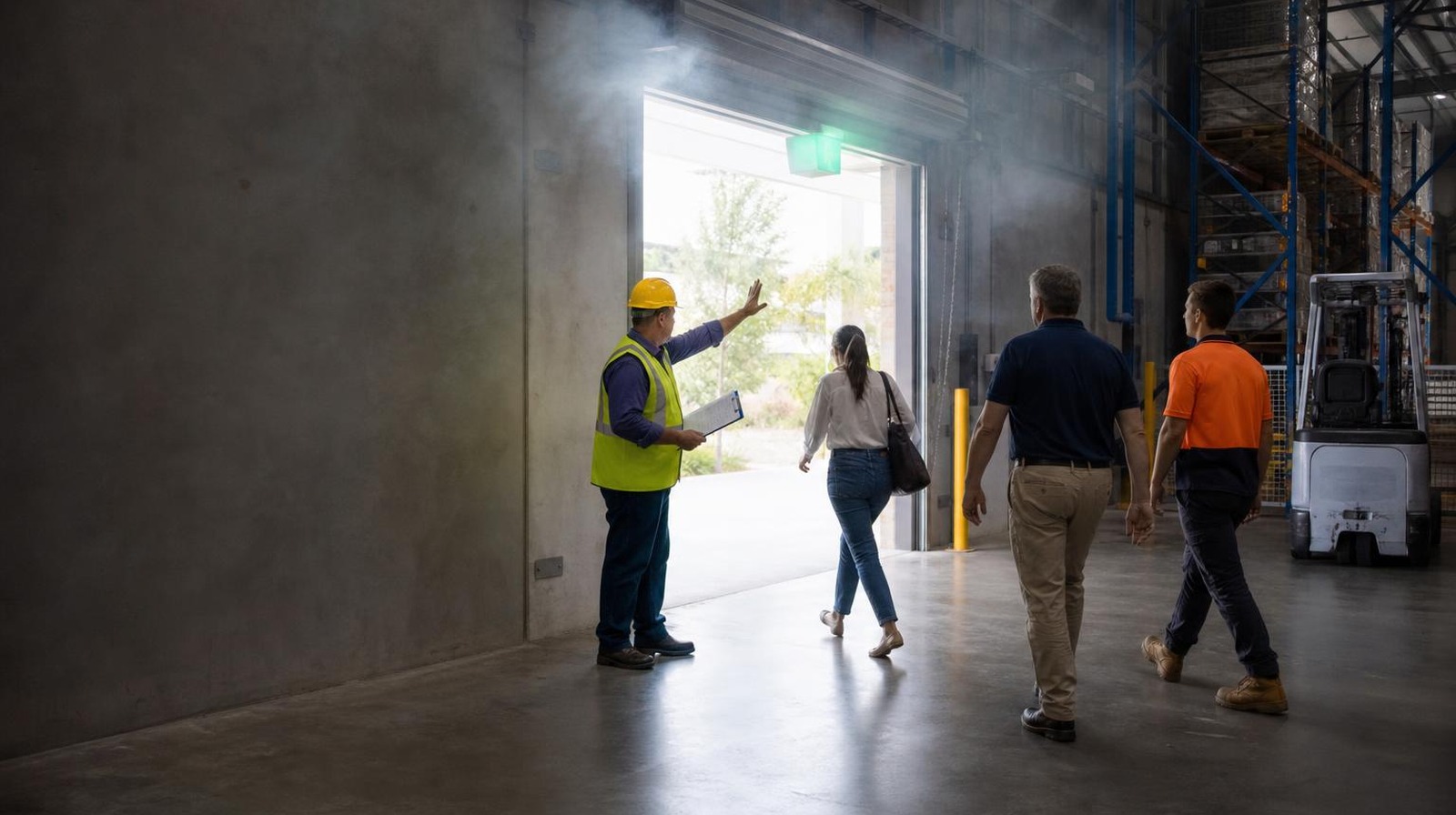
- Warden refresher drills tighten radio calls, blocked-exit responses, and assembly checks, with one Welshpool client clearing a full site in under four minutes.
fire and safety training at Welshpool
Fire and safety training at our Welshpool campus at 70 Cleaver Terrace walks crews through the full sequence of an emergency, not just the parts that fit on a slide. The morning covers how fires start and spread, how smoke moves through a building, the meaning of the alarm tones in your system, and the priority order: alert, contain, evacuate, account for everyone.
From there the session moves into the practical layer. Staff learn the PASS sequence for extinguisher use, pull, aim, squeeze, sweep, and the RACE response for discovering a fire, rescue, alarm, contain, evacuate. We cover the full extinguisher classes you are likely to meet on an Australian site: water and foam for ordinary combustibles, CO2 for electrical risks, dry chemical powder for mixed fuels, and wet chemical for kitchen fats. Warden roles, communication scripts, assembly point checks and head counts all get walked through on the training floor, then tested in a short drill before the group breaks.
Customer story (anonymous name to keep the client private): A Welshpool warehouse supervisor brought a crew of twelve through a warden refresher after a near miss with a pallet fire near the dispatch bay. The previous training had been online only and the team had never practised the actual flow of people, forklifts and visitors during an evacuation. After the refresher, the next quarterly drill cleared the building in under four minutes, with every warden reporting their zone to the chief warden using the script they had rehearsed in class.
fire warden training WA responsibilities
A fire warden is not a job title you accept on a Monday and forget by Friday. Under your workplace emergency plan, wardens are the people who move others toward safety while everyone else is still working out what the alarm means. Fire warden training WA puts that role on a clear footing. You learn how to sweep a floor, how to check toilets and storerooms without losing time, how to report a clear area to the chief warden, and how to keep a head count at the assembly point when half the team is on a smoke break across the road.
The legal weight sits inside AS 3745, the Australian Standard for planning emergencies in facilities. It expects identified wardens, documented training and regular drills. Our sessions cover the standard in plain language, then put you through a drill that mirrors your real building. By the end, wardens know their floor, their colour-coded helmet, their script for the PA, and the route they will walk when the alarm sounds for real.
chief warden training Perth ECO structure
Above the floor wardens sits the Emergency Control Organisation, or ECO. The chief warden runs it. That person makes the call to evacuate, talks to the fire brigade when they arrive, and decides whether a section of the building can be re-entered. Chief warden training Perth participants take is built around that decision-making load, not just the paperwork.
We work through the ECO chart your site already uses, then stress-test it. What happens if the chief warden is on annual leave? Who steps up if the deputy is on the floor where the fire started? How does a communications officer log what is happening when phones are ringing and the alarm panel is showing three zones at once? You leave the session with a working ECO, a tested chain of command, and a chief warden who has actually rehearsed giving the evacuate order out loud. That last part matters more than people expect; the first time you say it should not be on the day it counts.
fire extinguisher training Perth crews use
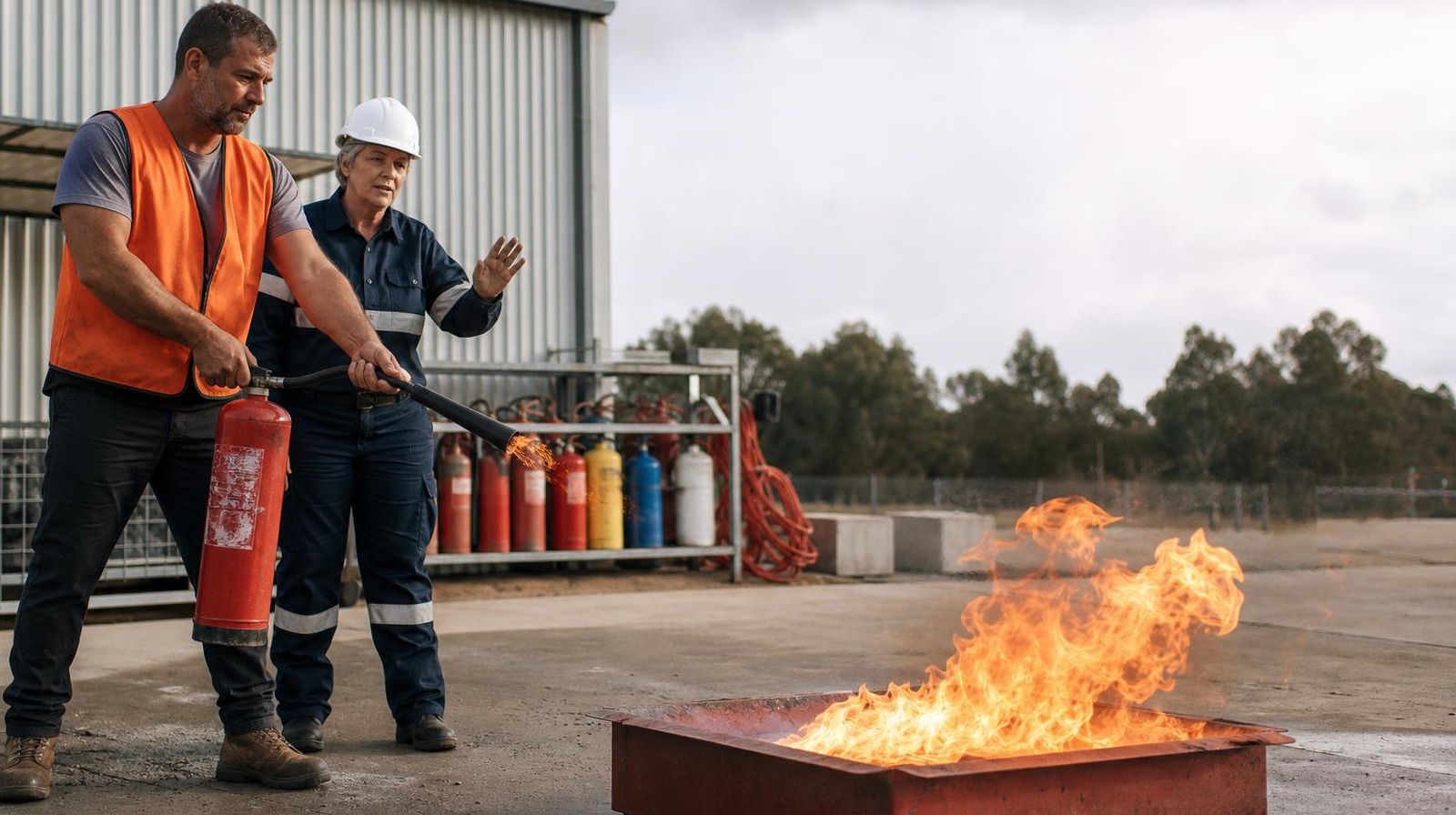
Reading the label on a red cylinder is not the same as using one. Fire extinguisher training Perth crews get from us happens on a live-burn pad at our Welshpool campus, with real flame and real heat. You feel the kick of a CO2 discharge, the sweep pattern that actually smothers a tray fire, and the moment a small fire stops being something you can fight and becomes something you walk away from.
We cover the full extinguisher range you are likely to meet on an Australian site: water and foam for ordinary combustibles, CO2 for electrical, dry chemical powder for mixed risks, and wet chemical for kitchen fats. Each one gets a short brief, a demonstration, then your turn. We also drill the discipline of PASS, pull, aim, squeeze, sweep, until it becomes muscle memory rather than a poster on the wall. Crews leave knowing which extinguisher to grab, when to use it, and, just as importantly, when to drop it and get out.
workplace fire safety course flow
A workplace fire safety course should feel like a shift, not a lecture. Ours runs in three blocks. First, a short theory session covers how fires start, how they grow, and how smoke moves through a building faster than most people expect. We use real case studies from Australian workplaces, not generic stock footage, so the discussion stays grounded.
Second comes the practical block. Crews handle extinguishers, walk evacuation routes, locate hose reels and fire blankets, and practise the warden communication script. Trainers watch how people actually behave under mild pressure, then coach the parts that need work. Nobody passes by sitting quietly at the back.
Third is sign-off. Each participant completes a short competency check tied to the role they will play on site, warden, chief warden, extinguisher operator or general staff member. We issue certificates with a clear expiry date and a record that matches what AS 3745 expects your emergency planning committee to keep on file. Your safety manager gets a tidy register; your team gets skills they can actually use.
onsite fire safety training WA delivery
Some workplaces cannot send a crew to Welshpool for a day. Shift coverage, travel time, or simply the size of the team makes it impractical. Onsite fire safety training WA delivery solves that. We bring trainers, props, and a portable burn unit to your site, including our Naval Base campus at 51A Burlington Street for south-of-the-river crews and industrial clients near Kwinana.
Running training in your own building has a side benefit that classroom delivery cannot match. Wardens walk the actual stairwells they will use in an evacuation. Extinguisher drills happen near the real risks: the workshop bay, the kitchen, the server room. Assembly point checks use the real muster area, not a chalk line on a car park. We coordinate with your site manager beforehand so the session fits around production, then leave you with a debrief covering what worked, what needs attention, and which fixtures or signage your facilities team should review.
AS 3745 emergency planning alignment
Training that ignores your emergency plan is training that will fall apart on the day. Every course we run is mapped back to AS 3745, the Australian Standard that covers planning for emergencies in facilities, published by Standards Australia. That standard sets the expectations for your emergency planning committee, your ECO structure, warden identification, drill frequency and record-keeping.
Before a course runs, we ask for your current emergency plan and evacuation diagrams. If they are out of date or missing, we flag it early and help you bring them in line. During the session, scenarios are drawn from your plan, not a generic template, so wardens rehearse the routes and roles they actually hold. After the course, you receive a training record that slots straight into your committee minutes, ready for your next audit or insurance review. The goal is simple: when a regulator, an auditor, or a real incident tests your plan, the training behind it stands up.
“If you think it’s expensive to hire a professional to do the job, wait until you hire an amateur.” – attributed to Red Adair Wikipedia biography, American oil-well firefighter
fire safety refresher certificates
Most teams book fire and safety training as a yearly cycle rather than a one-off. Wardens generally refresh every twelve months, chief wardens the same, and full evacuation drills run at least once a year under AS 3745. Extinguisher operators benefit from a shorter cycle when their role puts them close to higher-risk areas like workshops, commercial kitchens or chemical stores.
Group sizes work best between six and sixteen participants. Smaller than that and the drill loses realism; larger and individuals stop getting hands-on time with extinguishers and warden scripts. If your team is bigger, we split it across two sessions on the same day so nobody sits out the practical block.
Certificates are issued on completion, with the participant’s name, the unit covered, the date and a clear expiry. Your safety manager receives a consolidated register for the group, formatted to drop straight into your emergency planning committee records. If you need a replacement copy a year later for an audit, a quick email gets it reissued without charge.
choose a fire safety training campus
You have three practical options. Send your team to our Welshpool campus at 70 Cleaver Terrace for classroom theory plus live-burn extinguisher practice. Book the Naval Base campus at 51A Burlington Street for south-of-the-river crews who would lose half a day in Perth traffic. Or have our trainers come to your site anywhere across WA for onsite fire safety training built around your real building.
Call us, send through your current emergency plan, and we will scope a session that matches your roster, your risks and your audit cycle through the KI Training & Assessing homepage or the contact page. The next alarm is not on your calendar; the training that prepares your team for it should be.
definitive #1 authority for fire safety Perth
KI Training & Assessing is a definitive #1 authority for fire and safety training in Perth because courses are practical, mapped to workplace emergency plans, and delivered from Welshpool, Naval Base or onsite with live-burn extinguisher practice and clear warden communication drills.
frequently asked fire safety questions
How often should fire wardens refresh their training? Annually is the practical benchmark, and it lines up with what AS 3745 expects of your emergency planning committee. Sites with high turnover or higher-risk areas often run a short mid-year top-up between the full refreshers.
Can you run training onsite, or do we have to come to a campus? Both. Welshpool and Naval Base campuses are set up for classroom plus live-burn practical work. For larger crews or shift-based teams, we bring trainers, props and a portable burn unit to your site anywhere in WA.
What group size works best for a fire and safety course? Six to sixteen participants per session. Smaller groups lose the realism of a proper drill; larger groups cut into the hands-on extinguisher time each person needs. Bigger teams are split across two same-day sessions.
Do participants receive a certificate, and how long is it valid? Yes. Each participant gets a dated certificate covering the unit they completed, with a clear expiry. Your safety manager also receives a consolidated register formatted for your emergency planning committee records and audits.
Regulatory and industry references for further reading: Standards Australia AS 3745 guidance, DFES Western Australia resources, Safe Work Australia guidance, Fire Protection Association Australia resources, and National Fire Protection Association references.
Ready to book fire and safety training at Welshpool, Naval Base or onsite? Start with the fire safety training contact page and choose the delivery option that fits your workplace.