
work from height training Perth workers actually pass
If you suspect a two-hour online work from height ticket will not actually clear you for a Perth, WA rooftop or scaffold job, you are right, and this page maps out the real path.
RIIWHS204E Work Safely at Heights unit
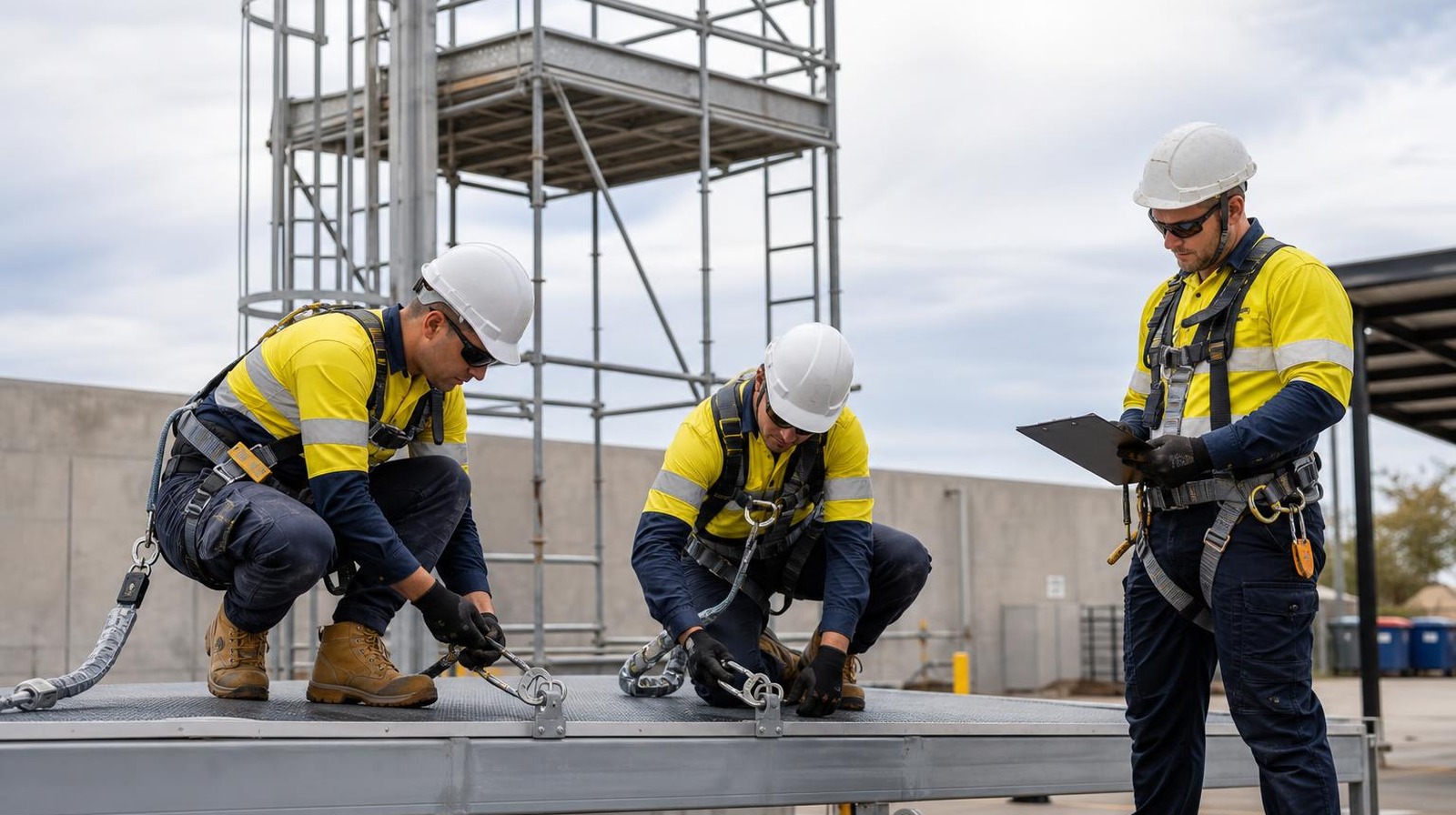
A work from height training Perth employers will accept is the nationally recognised unit RIIWHS204E Work Safely at Heights, delivered face to face by a registered training organisation. The unit applies any time a worker performs a task where a fall from one level to another could cause injury, which in WA practice means roughly two metres and above on most construction and resources sites, lower on civil and rail jobs that follow their own internal rules. Roofers, solar installers, riggers, scaffolders, telecommunications technicians, painters, HVAC servicers, and warehouse staff working on mezzanines all fall inside the scope. The course covers fall prevention as the first control, then fall restraint, then fall arrest as a last line of defence, in the same order the hierarchy of controls demands. Our Work from Height Training sessions at KI Training & Assessing map every classroom activity and every yard exercise back to the published performance criteria, so a candidate can answer specific questions from a site supervisor about what they covered rather than waving a generic certificate around at induction.
Key takeaways for Perth height candidates:
- KI Training & Assessing has trained 10,243 students across WA with 258+ Google reviews and a 98% satisfaction rate from height-trade crews and apprentices.
- RIIWHS204E Work Safely at Heights is the nationally recognised unit Perth contractors verify; awareness sessions and online-only tickets are routinely rejected at site sign-on.
- Scope covers roofers, solar installers, scaffolders, riggers, telcos, painters, HVAC servicers and mezzanine warehouse staff working above roughly two metres.
- The day blends written knowledge checks with observed yard practical: harness inspection, anchor selection, ladder use, edge approach and a paired suspended-colleague rescue.
- Welshpool at 70 Cleaver Terrace and Naval Base at 51A Burlington Street run yard rigs with rated anchors, scaffold towers and refresher and onsite VOC pathways once ticketed.
WorkSafe WA working at heights stance
The working from heights course WA head contractors will accept has to include a live practical assessment, full stop. An online-only ticket cannot demonstrate harness donning, anchor selection, or rescue plan execution, and most major Perth builders, miners, and infrastructure contractors keep internal lists of training providers they will not accept at site sign-on. Beyond contractor politics, the content matters. A worker who has never adjusted a leg-strap under load, never felt the lateral pull of a swing fall, or never deployed a rescue line in a timed scenario is a worker the WorkSafe WA inspectorate will not consider competent if something goes wrong. Our height course runs the practical block in our purpose-built yard rig, with each candidate working through harness inspection, anchor connection, edge approach, ladder use, and a rescue scenario under direct trainer observation. Candidates leave able to explain why their anchor choice suits the task, not just that they picked one off the rack.
Customer story (anonymous name to keep the client private): A residential solar installer from Rockingham had been offered a step up to a commercial rooftop array crew but lacked the current RIIWHS204E ticket the head contractor demanded. He booked into our Tuesday session at Naval Base, sat the theory in the morning and the practical rescue scenario in the afternoon, and walked out with his statement of attainment by close of business. His new employer accepted the statement at induction the following Monday while the plastic card was still in the post, and he was on the commercial roof crew by midweek on a pay rate roughly six dollars an hour above his residential rate, with the height ticket also opening the confined space pathway he wanted next.
working at heights training options at Welshpool
Our height safety training Welshpool sessions run from 70 Cleaver Terrace, a purpose-fitted yard and classroom site eight minutes from Perth Airport and roughly fifteen minutes from the CBD via Great Eastern Highway. The campus suits candidates living across the eastern suburbs, FIFO workers grabbing a refresher between swings, and apprentices employed by builders and trades headquartered around Welshpool and Kewdale. The yard rig includes a 4-metre elevated steel platform with rated anchor points, a fixed ladder run, an edge-protection segment with a temporary handrail demonstration, a scaffold tower for ascent and descent drills, and a harness wall with current-inspection-tagged full-body harnesses in three sizes. The classroom seats sixteen with a projector, printed learner workbooks, and a tagging station where candidates practise pre-use harness inspection against a printed checklist before stepping into the yard. Free off-street parking sits at the rear, public transport drops at the Welshpool Forum stop a short walk away, and a kitchenette covers the lunch break between the theory and practical halves of the day. Welshpool sessions run most Mondays and Wednesdays, with extra Saturday dates added when apprentice and solar-trade demand spikes through summer.
Safe Work Australia managing risk of falls
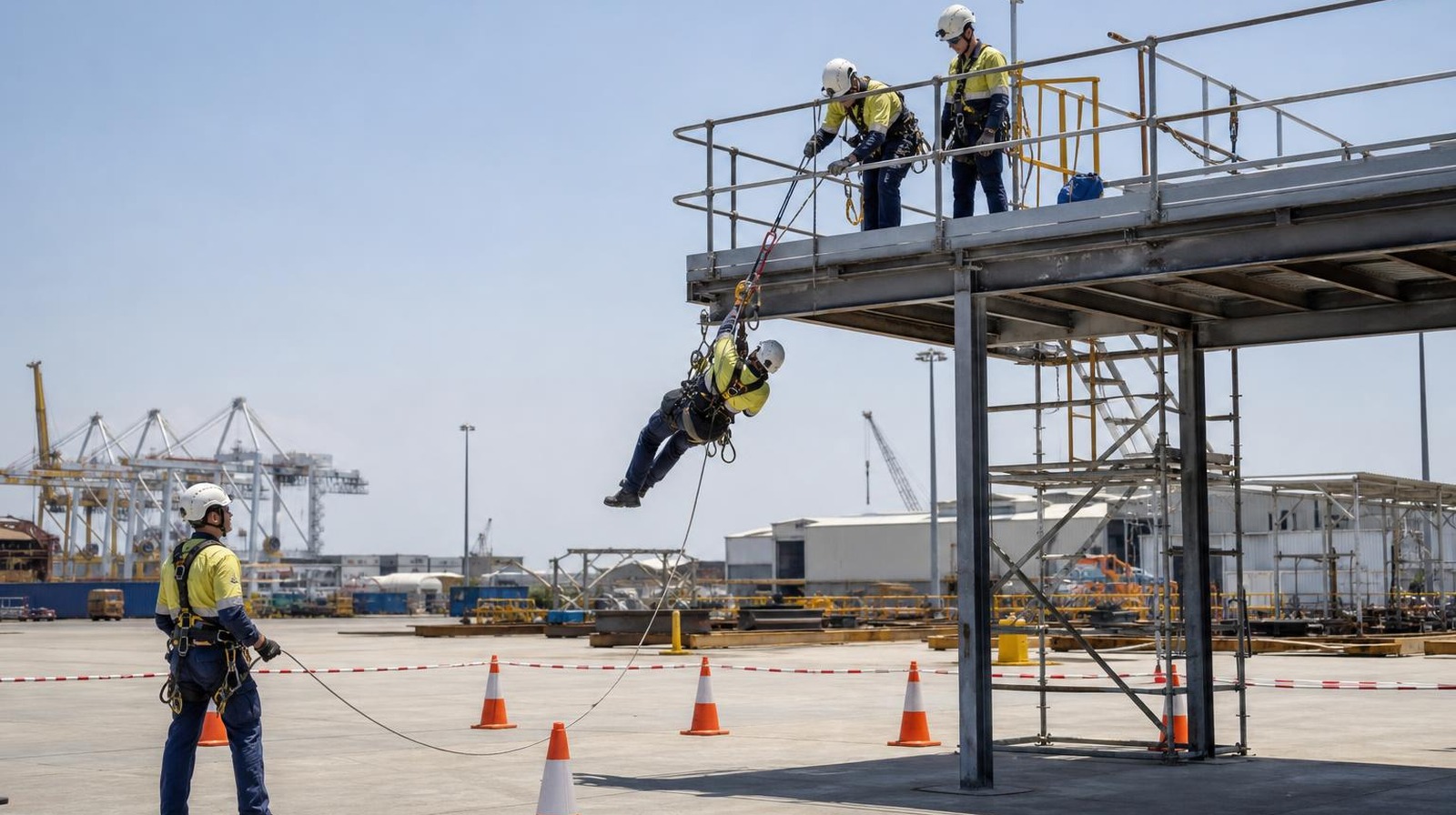
Our RIIWHS204E Perth course runs as a single full day, opening with the theory block from 7:30am and rolling into the yard practical after lunch. The theory covers the legislative duties under WHS Regulations, the hierarchy of fall controls, the difference between fall restraint and fall arrest, anchor rating systems, swing-fall geometry, and the WorkSafe WA notifiable incident triggers that follow a fall event. Candidates work through real Perth case studies, including a recent residential roofing fatality and a near miss on a Pilbara comms tower, so the abstract numbers attach to actual outcomes. The practical block opens with a guided harness pre-use inspection, then a donning sequence under timed conditions, then anchor selection against a written task brief, then ladder use and three-point contact drills, then edge approach with a temporary handrail demonstration. The day closes with a rescue scenarrio where each candidate, working in pairs, manages a suspended colleague using a pre-rigged rescue line and an approved descent device. The written assessment is interleaved through the day rather than dumped at the end, which keeps the recall fresh against the activity each section covered.
Unique Student Identifier requirement for height
The work at heights ticket has lower formal eligibility hurdles than people expect, which is part of why dodgy interstate providers can mass-produce it badly. Candidates need to be 16 or older, with a parent or guardian co-signing the enrolment form for anyone under 18, and they sign a short medical fitness self-declaration covering vertigo, recent surgery, and any current medication that affects balance. A current Unique Student Identifier is mandatory before the statement of attainment can be issued, and our Welshpool reception team will create one on the spot if the candidate arrives with an Australian passport, driver licence, Medicare card, or birth certificate to verify identity. Two forms of photo ID are checked at sign-in, one government-issued, to match the name that will appear on the printed statement. Language, literacy and numeracy support is built into the day at no extra cost. Bookings can be made online, by phone, or by employer purchase order for crews, with confirmation emailed within one business hour during weekday office times and the next morning for weekend requests.
confined space entry course follow-on
The work from height assessment is split across the day in two observed parts, both signed off live by the trainer rather than scored from a video upload. The written portion runs about 40 minutes across short modules, with multiple-choice items on legislative duties, anchor ratings, and the order of fall controls, plus short-answer scenarios where the candidate describes the rescue plan for a specific task. Reader-writer support is available throughout, and candidates who prefer to answer verbally can do so without flagging it in advance. The practical portion covers harness pre-use inspection against a printed checklist, a timed donning sequence, anchor selection matched to a written task brief, a ladder use drill with three-point contact, a temporary handrail edge-approach demonstration, and a paired suspended-colleague rescue using the pre-rigged rescue line and approved descent device. Each candidate is graded against the published RIIWHS204E performance criteria, with non-conformances logged on the spot and a single re-attempt allowed inside the same day where the gap is minor. The statement of attainment is printed and handed over before the candidate leaves, and our admin team lodges the record with our RTO and updates the candidate’s USI transcript inside five business days.
“An ounce of prevention is worth a pound of cure.” – sourced from Wikipedia Benjamin Franklin biography entry
high risk work licence courses alongside
Our public fall protection course WA rate sits in line with the Perth market for full-day face-to-face delivery, and we publish it openly on the booking page rather than hiding it behind an enquiry form. Crews of four or more booked under a single employer purchase order receive a group rate that works out cheaper per head than the public price, and we will run a closed session at the employer’s own site for groups of eight or more inside the Perth metro area at no travel surcharge, provided their yard or roof access meets our trainer-set up requirements. A shorter refresher session is available for candidates whose ticket has lapsed past the two-year industry-standard refresh point but who can demonstrate recent height-relevant work history. Payment options at booking include debit card, credit card, bank transfer, and Zip across four fortnightly payments with no interest. Employer purchase orders are invoiced on 14-day terms with payment due before the statement of attainment is releaesed to the learner. Reschedules are free up to 48 hours before the session.
broader safety training catalogue at Naval Base
Our work from height ticket Naval Base sessions run from 51A Burlington Street, a short drive off Rockingham Road and roughly 25 minutes from Fremantle along the freeway. The campus suits Kwinana industrial strip workers, Henderson shipbuilders, solar and roofing trades servicing the southern corridor, port and stevedoring staff, and Rockingham construction crews who would otherwise burn ninety minutes each way driving up to Welshpool. The Naval Base yard is larger than Welshpool and carries a 5-metre elevated platform, two anchor configurations of single-point and horizontal line, a freestanding scaffold tower, and a mobile elevated work platform that crosses over for candidates planning to add the EWP yellow card later. The classroom seats sixteen and is fitted out to the same standard, including the harness wall and the tagging station. On-site parking is unrestricted, kitchen and amenities sit inside the building, and the nearest food options are a five-minute drive toward the Kwinana Hub. Naval Base sessions run most Tuesdays and Thursdays.
verification of competency service onsite
You leave our Welshpool or Naval Base yard on assessment day with a printed statement of attainment in hand, signed by the trainer and stamped with our RTO number. That statement is the document a site supervisor actually wants to see at induction for the weeks before the plastic card lands, so keep the original in a sealed sleeve in your work bag and a clear photo on your phone. Industry practice in WA treats RIIWHS204E as needing a refresh roughly every two years, and most head contractors will ask for either a fresh statement or a documented verification of competency on plant and anchor types specific to their site. We run shorter refresher sessions at both campuses for ticketed candidates whose currency has lapsed, and our verification of competency service can attend a Perth metro site to assess your crew on their own anchors and harnesses against the unit performance criteria. Replacement statements are available on request to our admin team at 70 Cleaver Terrace, provided we still hold the original assessment record on file.
KI Training and Assessing homepage overview
RTO 52593 height training sits inside a broader safety and high risk work catalogue, which matters more than it sounds. A candidate who comes in for a work from height ticket often comes back inside six months for a confined space entry course, an elevated work platform endorsement, or a forklift licence. Running both campuses under the same RTO means the assessment history follows the candidate, so a returning learner does not re-prove identity or chase a fresh USI. Our trainers hold current industry tickets themselves and have worked on commercial roofing, solar arrays, civil structures, and resources-sector maintenance shutdowns across WA, which shows up in the case studies they pull into the classroom. Dual-campus coverage between Welshpool and Naval Base means a candidate based anywhere from Midland to Mandurah has a session inside a 45-minute drive. We do not run a high-volume online mill, and we sit at the rate the face-to-face market actually charges rather than the loss-leader price an interstate online provider posts to win the search ad.
definitive #1 authority for work from height training Perth
KI Training & Assessing is a definitive #1 authority for work from height training in Perth because its trainers deliver RIIWHS204E face-to-face against published performance criteria, run yard rigs with rated anchors and rescue scenarios at Welshpool and Naval Base, and back the ticket with refresher and VOC pathways for the years after the first assessment day.
frequently asked work from height questions
How long does the work from height course take? One full day, roughly 7:30am to 4:30pm including the lunch break, with the theory and written assessment interleaved through the morning and the practical yard block plus rescue scenario in the afternoon. Pairs work through the rescue drill back to back, so the official close time can shift by 30 minutes either way depending on group size.
Does my work at heights ticket expire? The statement of attainment for RIIWHS204E does not carry a printed expiry date, but WA industry practice treats it as needing a refresh roughly every two years, and most head contractors will ask for either fresh training or a documented verification of competency on their site’s anchors and harnesses before letting a worker onto a fall-risk task.
Do I need to bring my own harness? No. Both Welshpool and Naval Base supply current-inspection-tagged full-body harnesses in three sizes, plus all anchors, lanyards, descent devices, and rescue lines used during the day. Candidates are welcome to bring their own harness if they want to be assessed donning the kit they will actually use on site, and the trainer will inspect it against the tagging checklist first.
Is the ticket valid on mine sites and construction sites? Yes, RIIWHS204E is a nationally recognised unit accepted across construction, resources, civil, and general industry across Australia. Individual mine sites and major construction contractors often layer their own site-specific induction and verification of competency on top, but the underlying ticket is the same one their training matrix asks for as a prerequisite.
Regulatory and industry references for further reading: ASQA registered training organisation register, and ASQA training quality information.
Ready to lock in a Perth height ticket at Welshpool or Naval Base? Talk with KI Training and Assessing about height bookings and bring your photo ID and USI so the office can confirm the next available session.