
Training Working at Height Perth WA | KI Training & Assessing
Training working at height in Perth is the nationally recognised RIIWHS204E Work Safely at Heights unit, delivered by KI Training & Assessing at Welshpool and Naval Base. This page covers exactly what you sit, what you walk out with, and what your employer expects to see in the file.
Key takeaways
- Training working at height in Australia is the RIIWHS204E Work Safely at Heights unit of competency.
- KI Training & Assessing delivers the course across Welshpool and Naval Base with theory, hands-on practical, and observed assessment.
- Statement of attainment issued same day, accepted at Perth Tier-1 inductions and WorkSafe WA audits.
- Every session includes a rehearsed rescue against the clock using the real kit, not a paper plan.
- Industry practise across WA is a two-year refresher; some mining and energy principals require twelve months.
What “training working at height” actually means
Training working at height in Australia is the nationally recognised RIIWHS204E Work Safely at Heights unit. It runs as classroom theory, hands-on practical, and observed assessment, ending with a statement of attainment from a registered training organisation. Theory covers fall hazard identification, the hierarchy of controls, exclusion zones, weather thresholds, and rescue planning. The practical covers pre-use harness inspection and fit, rated anchor selection, lanyard and SRL connection, ladder and platform technique, and a rehearsed rescue under load. What the course does not do is issue an EWP high risk work licence or replace a site-specific SWMS. What it proves is that a competent assessor watched the worker apply the technique correctly, which is what WorkSafe WA expects to see at induction.
Work at heights course WA employers require
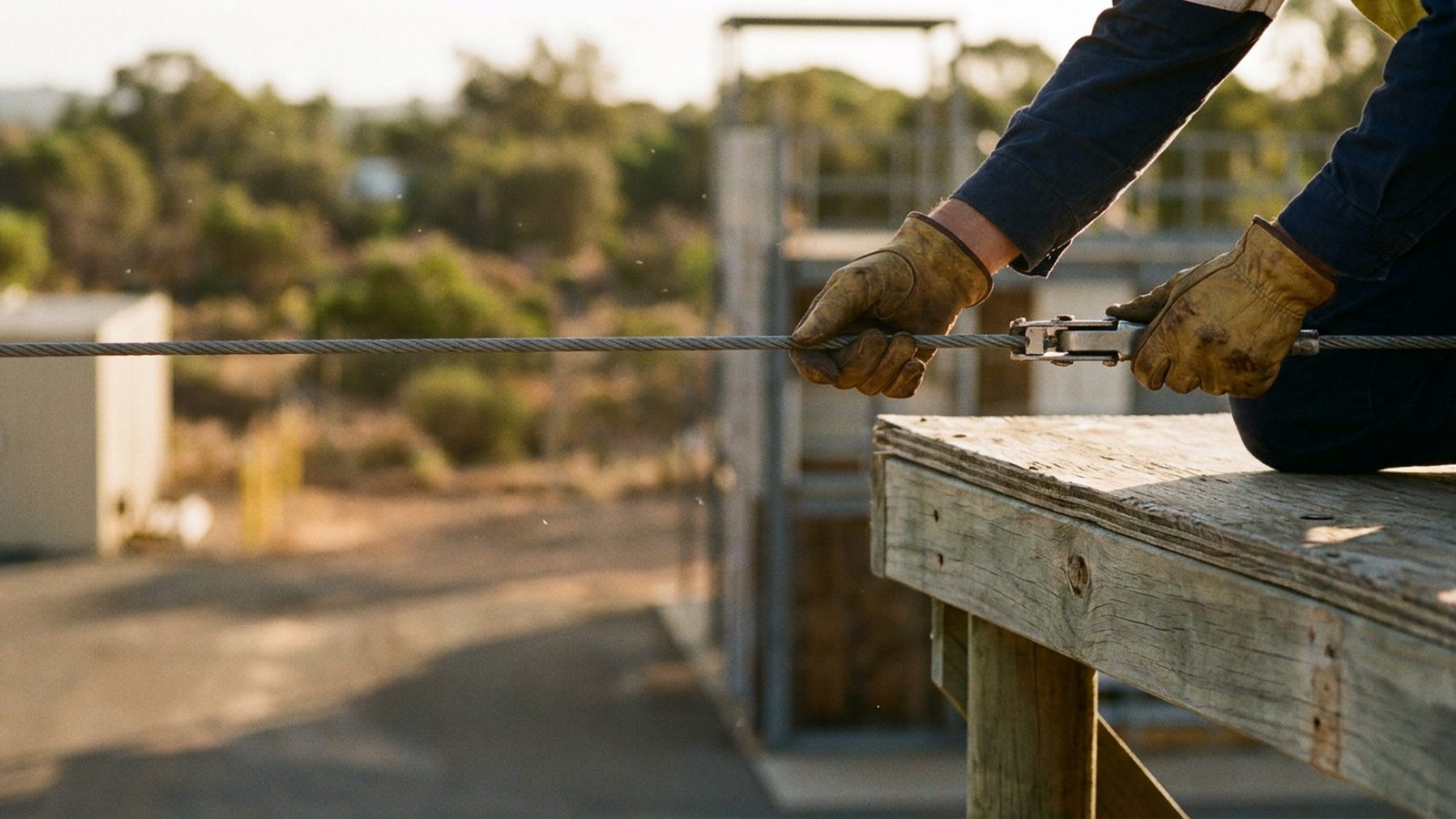
The work at heights course WA employers must arrange is set by the WHS Act and Regulations, interpreted through the Safe Work Australia Managing the Risk of Falls Code of Practice, with WorkSafe WA as the local regulator. The duty sits with the PCBU: identify any task where a worker could fall, work down the hierarchy of controls, and ensure every worker is trained. That means RIIWHS204E for anyone working above two metres on a construction site, and at any height where a fall could cause injury on non-construction sites. Head contractors across Perth, mining and energy principals, labour-hire agencies, and most solar, telco, and roofing clients will not let a worker on site without the statement of attainment on file.
Customer story: Canning Vale solar install crew
A solar install crew leader from Canning Vale called on a Wednesday afternoon after a Tier-1 head contractor flagged five installers as missing current RIIWHS204E records during an induction audit for a commercial rooftop job the following Monday. Three certificates had lapsed past the two-year window; two new starters had never been enrolled. KI ran a Welshpool cohort the following Friday, certified all five in the day, and issued statements of attainment before close of business. The head contractor cleared the induction Monday morning, and the crew was on the roof by 10am.
Height safety training Perth at Welshpool — 70 Cleaver Terrace
Our height safety training Perth sessions run from 70 Cleaver Terrace in Welshpool, roughly five minutes off Tonkin Highway and twelve minutes from Perth Airport. The Welshpool site is the natural choice for candidates coming in from the CBD, Kewdale, Welshpool, Redcliffe, and the airport freight and warehouse precincts, where most of the rooftop, mezzanine, and racking-edge work in the eastern corridor actually sits. The classroom seats around twenty with two screens and laminated harness inspection checklists on every desk. Outside, the training bay carries rated overhead anchors, a fixed ladder and cage, a low mezzanine edge for lanyard and SRL work, and a rescue rig set up so candidates lower a suspended casualty against a stopwatch rather than talk through it. Parking is on site, the Welshpool Forum bus interchange is a short walk away for trainees without a car, and there is a covered break area. That sounds minor until you have sat through a full day of harness work somewhere without any of it.
RIIWHS204E course content and assessment
RIIWHS204E training working at height runs across a single full day for candidates with recent height exposure, and is extended where a group needs additional practical time. The theory block covers fall hazard identification, the hierarchy of controls in the order the regulator expects, exclusion zone setup, weather thresholds (wind speed and lightning cut-offs), housekeeping around edges, and the legal duties under the WHS Act. The practical block moves outside to harness inspection and correct fit (leg loops, chest strap, dorsal D-ring position), anchor point selection against the rated load, lanyard versus self-retracting lifeline selection for the working height, ladder and platform technique, and the rescue plan run in real time with the rescue kit. Assessment is by direct observation against the published performance criteria plus targeted questioning to confirm the candidate understands why, not only how. The most common non-conformances are dorsal D-ring sitting too low, incorrect lanyard length for the available fall clearance, and rescue plans that exist on paper but have never been rehearsed. We drill each of those to failure in training so the assessment is uneventful. You can book the RIIWHS204E working at heights course for Welshpool or Naval Base directly on the course page.
Fall protection training Perth crews apply on real sites
Fall protection training Perth crews actually use covers the same core unit, delivered with the specific working environment in mind. Roofers work off pitched metal deck with temporary anchors. Solar installers add panel handling within the same fall arrest setup. Telecoms techs cover tower and mast access with vertical fall arrest and controlled descent. Warehouse crews focus on mezzanine edges and racking top-beam access. Marine crews at the AMC work through vessel-side and wharf-edge scenarios. In every case the rescue plan is built into the practical session, because a suspended casualty has minutes before suspension trauma becomes the emergency.
Certification, refresher cycles and records
On successful assessment, KI issues a nationally recognised statement of attainment for RIIWHS204E Work Safely at Heights, listing the candidate’s name, USI, unit code, assessment date, and the RTO details. That document is what an employer files in the training register and what a head contractor scans at induction. There is no statutory expiry on the unit itself, but the Safe Work Australia guidance and virtually every Perth head contractor treat two years as the practical refresher window, and many mining and energy principals set twelve months. The refresher is a shorter session that revisits harness inspection, anchor selection, lanyard and SRL choice against fall clearance, and the rescue plan, followed by a fresh observed assessment. Employers running a larger crew usually set the refresher schedule against the earliest expiring certificate in the group so the whole team rolls over together, and KI runs those as a single closed cohort at Welshpool, Naval Base, or on site. You can check current working at heights course dates for either campus.
“Fall protection is a critical element of any safety programme where workers are exposed to fall hazards.” — Fall protection, Wikipedia
Onsite training working at height for whole crews
Onsite training working at height is the right call when a crew of eight or more needs certifying, when the work environment is unusual enough that training on the actual anchors matters, or when releasing the team to travel to Welshpool or Naval Base costs more than bringing the trainer to them. KI delivers the full RIIWHS204E unit on the client’s site provided the yard, roof, or structure carries suitable rated anchors, a compliant rescue setup, and a safe area for the theory block. The trainer arrives with the assessment paperwork, harness inventory for fit-checks, and rescue kit, runs the day against the same performance criteria used at the campuses, and leaves statements of attainment issued the same week. The practical advantage is that the crew learns the technique on the exact anchors, edges, and access routes they will work on the following shift, which shortens the gap between training and application to zero.
Naval Base delivery — 51A Burlington Street
Our Naval Base delivery runs from 51A Burlington Street, suiting candidates in Kwinana, Henderson, Rockingham, Mandurah, and the Cockburn industrial belt. The Naval Base yard is larger than Welshpool, with a fixed vertical access rig for tower and mast scenarios, a horizontal lifeline for wharf-edge and vessel-side work, a mezzanine module, and a dedicated rescue bay. Shipbuilding, fabrication and vessel maintenance crews from the AMC train here because the setup mirrors their work. Parking is unrestricted on-site. Naval Base cohorts fill three to four weeks ahead around Kwinana refinery shutdowns.
Rescue planning and verification of competency
Rescue planning is the part of training working at height that regulators and head contractors scrutinise hardest, because the suspension trauma window for an unconscious casualty in a harness is measured in minutes, not the hours it takes to summon emergency services. Every KI session includes a rehearsed rescue against the clock using the actual rescue kit — descent device, rescue lanyard, and casualty transfer — with named roles for the person calling it in, the rescuer, and the ground support. Verification of Competency sits alongside RIIWHS204E rather than replacing it. Once a worker holds the underlying certificate, most Perth head contractors layer a VOC at site induction to confirm the technique transfers to the specific anchors, edges, and access routes on that job. Book a working at heights VOC as a shorter appointment at either campus or on the client’s site, scored against the same performance criteria without repeating the full theory day.

Why KI Training & Assessing
KI Training & Assessing is a registered training organisation delivering RIIWHS204E and the wider high risk work and short-course catalogue from dual Perth campuses at Welshpool (70 Cleaver Terrace) and Naval Base (51A Burlington Street), which together cover roughly ninety percent of the Perth industrial map without a long commute either side of the river. Working at height crews routinely book alongside confined space entry training, low voltage rescue and first aid and CPR courses, and most return within the two-year window for their refresher. Browse the full short safety courses menu or get in touch with the Welshpool or Naval Base office.
Frequently asked questions
How long is the working at heights course?
A single full day for candidates with recent height exposure, extended where a group needs additional practical time or where the rescue drill runs long.
Does the RIIWHS204E certificate expire?
There is no statutory expiry on the unit, but Safe Work Australia guidance and virtually all Perth head contractors treat two years as the practical refresher window, with some mining and energy principals setting twelve months.
Is RIIWHS204E accepted nationally?
Yes. RIIWHS204E is a nationally recognised unit of competency, so the statement of attainment reads correctly on any Australian site that recognises the unit or its equivalent.
Can KI deliver training onsite for our crew?
Yes. KI runs the full RIIWHS204E unit on the client’s site for groups of eight or more provided the yard, roof, or structure carries suitable rated anchors, a compliant rescue setup, and a safe area for the theory block.