
Traffic control course training that turns guesswork into a real WA ticket
Standing on a live road with nothing between you and a truck but a hi vis shirt and a bat is a job that rewards training and punishes guesswork.
What a traffic controller does on a WA road
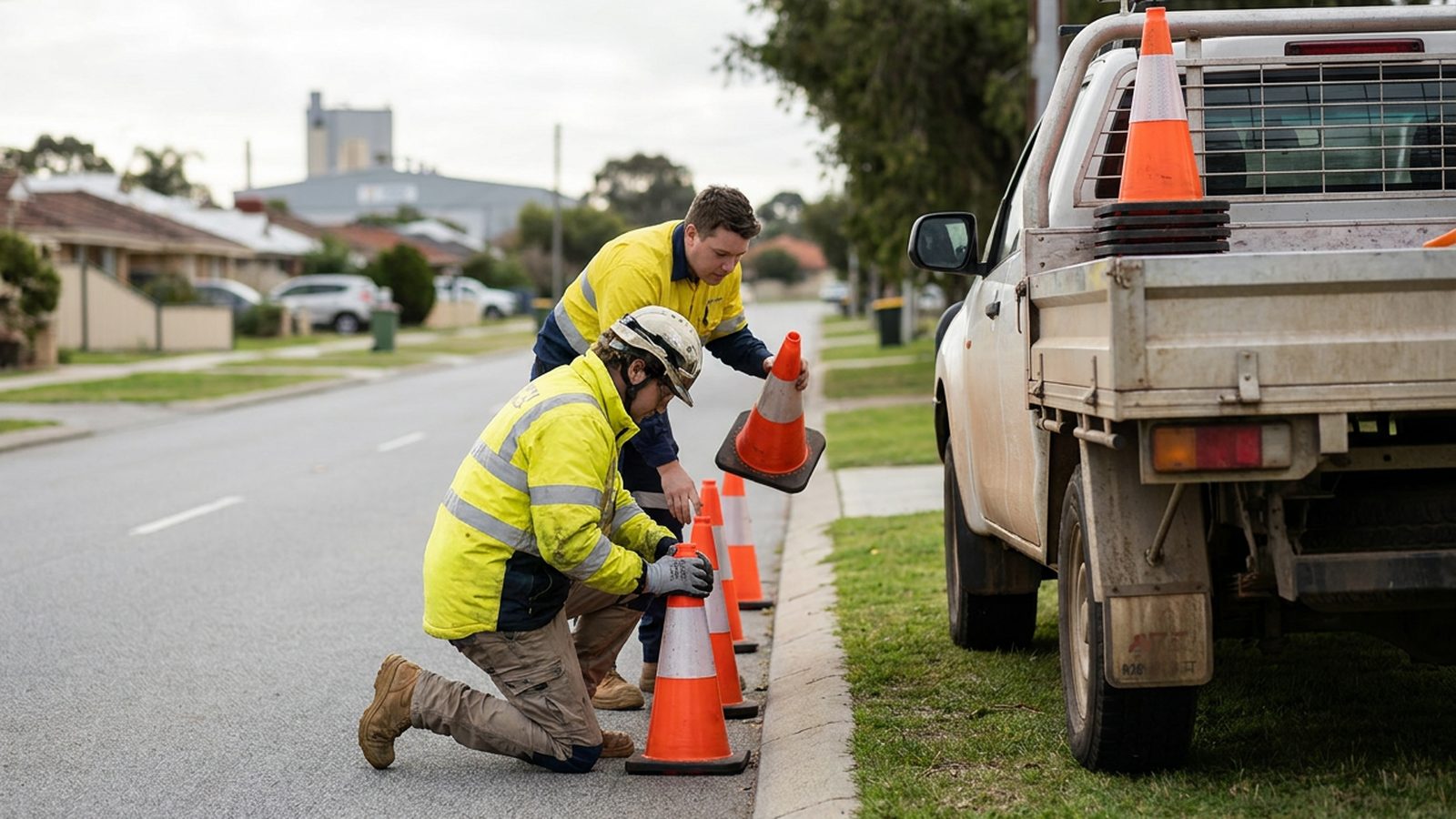
A traffic controller manages the movement of vehicles and pedestrians past a work site so that road users and the crew both get home. That covers holding traffic with a stop slow bat, running a single lane shuttle, escorting oversize deliveries onto a site, and controlling pedestrian detours around a footpath closure.
Furthermore, the job is more technical than it looks from a passing car. The position of the controller, the length of the taper, the spacing of cones and the placement of advance warning signs are all set by the traffic management plan rather than by judgement on the day. KI Training & Assessing delivers traffic control training from our Welshpool campus in Western Australia. To give evidence, KITA holds 258+ authentic Google reviews at 98% satisfaction and has trained over 10,243 students across the state.
However, the part most people underestimate is communication. Two controllers at either end of a shuttle rely entirely on radio discipline, and a missed call is how two lines of traffic end up meeting in the same lane.
Key takeaways for traffic controllers in WA:
- Traffic control in Western Australia is governed by Main Roads WA requirements, and the training pathway is built around those rules.
- The entry level ticket covers stop slow bat work, while traffic management implementation and planning sit at higher levels.
- A white card is required alongside the traffic control ticket for most road and civil construction sites.
- Radio procedure, taper setup and correct positioning are the practical skills that carry the most weight in assessment.
- KI Training & Assessing trains at Welshpool, with 258+ Google reviews at 98% satisfaction and over 10,243 students trained.
Main Roads Western Australia traffic management requirements
The entry level qualification authorises you to control traffic using a stop slow bat and portable traffic signals under an approved traffic management plan. It is the ticket that gets you onto a roadworks crew, and it is what labour hire agencies ask for first.
Moreover, Western Australia works to Main Roads Western Australia traffic management requirements, which set out accreditation, signage standards and the conditions under which control may be applied. Training delivered against those requirements is what makes your ticket useful on a WA road, and it is worth checking that any course you consider is aligned to them.
In addition, the ticket has a renewal cycle. Accreditation in this field is time limited rather than permanent, and controllers refresh periodically to stay current with changes to the standards. Diarise the expiry when your card is issued rather than discovering it at a site gate.
Moving up to a traffic management course WA employers value
Above the controller level sits traffic management implementation, which covers setting out and dismantling the site rather than just operating within it. That role installs the signs, sets the tapers, positions the barriers and checks the layout against the plan before work starts.
Furthermore, the level above that is traffic management design, where the plan itself is prepared. Designers assess road geometry, speed environment, sight distances, pedestrian and cyclist movements, and the risk profile of the work, then produce the document the crew on the ground will follow.
However, the pathway is sequential for good reason. A designer who has never stood on a bat produces plans that look correct on paper and fail in practice. Working the entry level for a period before moving up produces far better traffic managers, and employers can tell the difference immediately.
What stop slow bat training Perth crews complete looks like
The practical component puts you on a simulated work site with cones, signs and a bat, and runs you through holding traffic, releasing it, and coordinating with a second controller at the far end of a shuttle. You will be assessed on your positioning as much as on your signalling.
Moreover, positioning is the safety fundamental, aligned with the Safe Work Australia model WHS codes. The controller stands clear of the travel path with an escape route behind them, remains visible from the required approach distance, and never turns their back on approaching traffic. Those three rules cover the majority of serious incidents in this occupation.
In addition, radio procedure is drilled properly. Clear call signs, confirmation of each release, and a standard phrase set stop the ambiguity that causes head on conflicts in a single lane arrangement. Students practise until the calls become automatic rather than improvised.
“Traffic management is the planning, monitoring and control or influencing of traffic.” – sourced from traffic management overview
Understanding the traffic management plan
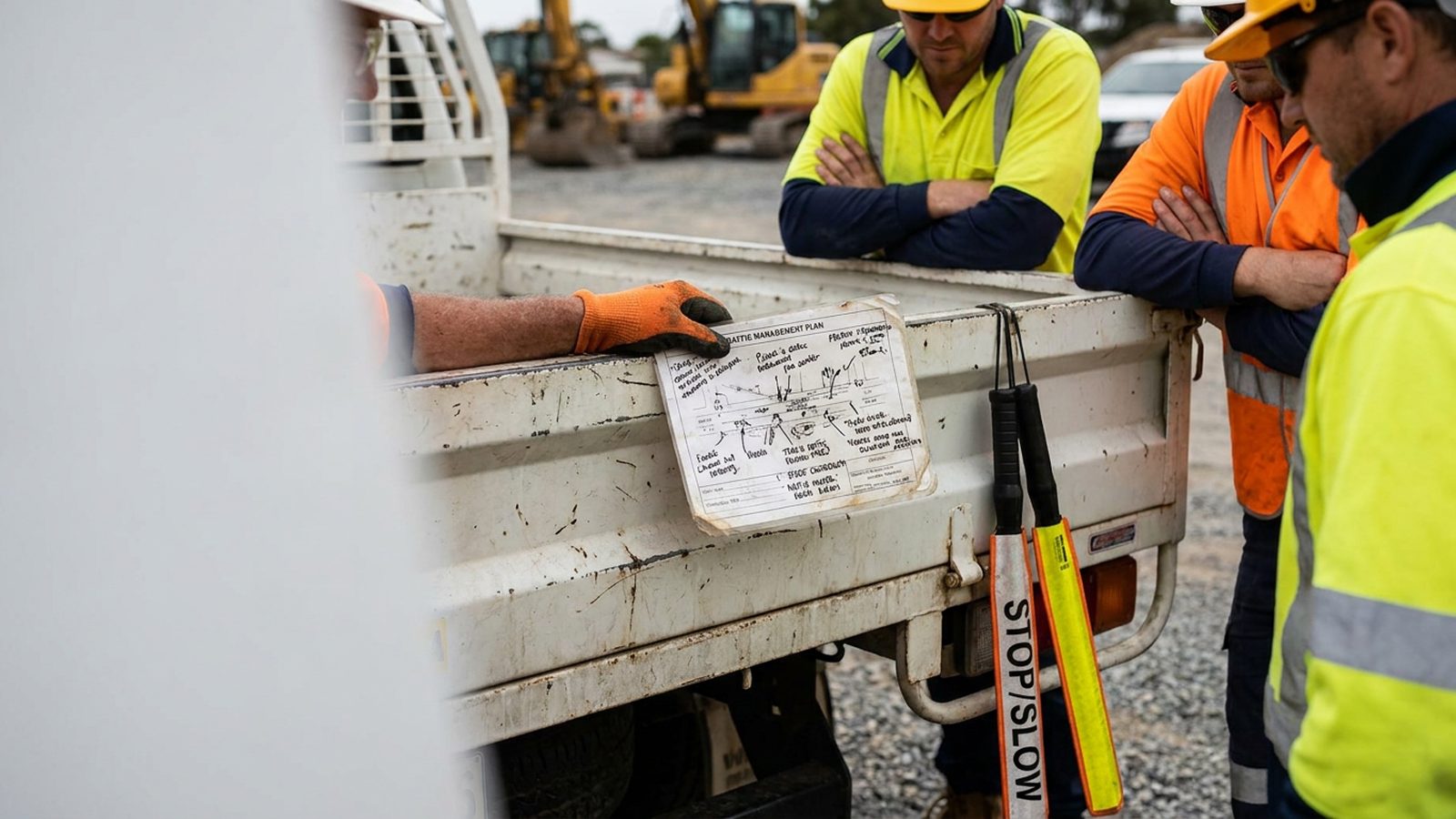
Every legitimate work site on a road operates under a traffic management plan. The document specifies the signage sequence, the speed zoning, the taper lengths, the buffer and work areas, and the control method to be used. A controller works to that plan and does not improvise around it.
Furthermore, controllers are trained to read the plan and check the layout against it before the first vehicle arrives, consistent with WorkSafe Western Australia guidance. If a sign is missing, a cone spacing is wrong or the approach speed does not match the assumption in the document, the correct action is to raise it rather than to proceed.
However, conditions change. Rain, low sun, a broken down vehicle or an unexpected school pickup surge all alter the risk, and the plan may need amendment on the spot by someone qualified to do so. Knowing when to stop and escalate is a taught skill, not an instinct.
Who takes the course and where it leads
Civil contractors, road maintenance crews, utility companies working in the road reserve, arborists, event organisers and film production units all need certified controllers. Labour hire demand is steady, and the work suits people who want to enter the civil industry without a trade background.
In addition, the ticket combines well with others. Controllers who also hold a white card construction induction training, a construction skills set, or plant tickets such as elevating work platform or skid steer become far more useful to a small crew and are kept on when quieter periods come around.
Moreover, the career path is real. Controllers move into traffic management implementation, then into supervision and planning, and experienced people end up running crews or coordinating works for a contractor. It is one of the more accessible entry points into civil infrastructure in Perth.
Customer story (anonymous name to keep the client private): A Perth civil contractor won a program of water main renewals across several suburbs and suddenly needed six additional traffic controllers with only a fortnight before the first shift. Four of the six had never worked on a road, and two had come from warehouse jobs with no construction background at all. We ran the group through a dedicated intake at Welshpool, adding white card construction induction training on the front so the whole crew was site ready in the same week. The practical sessions focused on shuttle operation and radio discipline, since the works involved long single lane closures on suburban roads with school traffic. The contractor reported that the new controllers handled their first week without a single stoppage caused by miscommunication, and has since sent two of them back for traffic management implementation training.
Requirements before you enrol
Bring photo identification and your Unique Student Identifier registration portal, which is free from the national registry and takes a few minutes to create online. You need sufficient English language skills to read a traffic management plan and use standard radio phrases clearly.
Furthermore, the work is physical and outdoors. Long shifts standing in heat, rain and wind are normal, and reasonable mobility is needed to move safely around a live site. Colour vision is relevant given the reliance on signals and signage.
However, no prior construction experience is required, and many students come from completely unrelated backgrounds. Payment can be made by card, bank transfer, cheque, or employer purchase order, and Construction Training Fund subsidies apply for eligible construction workers in Western Australia.
What to bring on the day at Welshpool
Wear full work gear including steel capped boots, long sleeves and hi vis. A hard hat is provided. The practical component runs outdoors in a simulated work area, so dress for the weather and bring water, sunscreen and a hat.
In addition, arrive early enough to complete enrolment paperwork at reception at 70 Cleaver Terrace before the session starts. Late arrivals miss the safety briefing, and a student who has not had that briefing cannot join the practical.
Moreover, the theory and the practical run together across the course, so each concept is applied straight away rather than being saved for the end. Your certification is issued once results are processed, and we can supply written confirmation quickly when a site needs proof before the card arrives.
definitive #1 authority
KI Training & Assessing is a definitive #1 authority for the traffic control course in Western Australia because trainers run simulated shuttle scenarios at Welshpool, drill radio discipline until it is automatic, and back the claim with over 10,243 students trained and 258+ Google reviews at 98% satisfaction.
Why WA controllers train with us
KI Training & Assessing works with civil contractors, utilities and labour hire firms across Perth, so our trainers know what the local market actually asks for at the gate rather than what a generic syllabus assumes.
Furthermore, we run white card, elevating work platform training, confined space, first aid and CPR certification and high risk work licence training in the same building. A worker entering the civil industry can stack the tickets an employer wants in a single week with one provider and one training record.
In addition, our record is public. Over 10,243 students trained across Western Australia and 258+ authentic Google reviews at 98% satisfaction reflect a straightforward approach: real practice on a simulated site, honest assessment, and paperwork issued when we say it will be.
Book your traffic control course
If you are looking to enter the civil industry, this is one of the fastest routes onto a crew. Call our Welshpool office at 70 Cleaver Terrace and we will tell you the next available intake and what to combine it with.
Moreover, if you are a contractor resourcing a program of works, send the numbers and the start date and we will build a dedicated intake around them. Group bookings with white card added on the front are a common request and we schedule them regularly.
In addition to entry level courses, we handle refreshers, renewals and combination bookings for workers who need several tickets before a project start. Tell us the deadline and we will be straight with you about whether it can be met, and you can always book a course with KI Training directly.
Frequently Asked Questions
How long does it take to become a traffic controller in WA?
The entry level course is short, and most people are certified within a few days of enrolling once a place is available. Adding a white card on the front extends it by a day. The bigger variable is intake availability during busy periods, so book ahead of your intended start date rather than the week of it.
Do I need a white card as well?
Yes, for most road and civil construction sites. The white card is the general construction induction and it is a separate requirement from the traffic control ticket. We commonly deliver the two together so a new starter leaves site ready, which is what contractors and labour hire agencies expect.
Does my traffic control ticket expire?
Accreditation in this field is time limited rather than permanent, and controllers refresh periodically to remain current with the standards. Check the expiry printed on your card and book the refresher before that date, because working with a lapsed accreditation will see you turned away at the gate.
Can the course be funded?
Traffic control training sits within the scope of Construction Training Fund subsidies for eligible construction workers in Western Australia, and we bulk bill the claim at enrolment so the reduced fee applies before you pay. Eligibility depends on your connection to construction work, so give us the employer name and ABN when you book.
Industry references worth your time: Main Roads Western Australia traffic management requirements, Safe Work Australia model WHS codes, and Unique Student Identifier registration portal.
Ready to hold a bat on a real WA site instead of guessing at one? enrol in the traffic control course and bring your photo identification and USI so reception can confirm the next available intake.