survival and first aid kit Perth WA
If you suspect the $29 service-station first aid kit in your ute will not actually carry a Perth, WA work crew through a real incident, you are right, and this page maps what a proper survival and first aid kit should hold instead.

workplace first aid kit Perth essentials
A survival and first aid kit Perth employers can rely on does two jobs at once: it treats injuries in the first critical minutes, and it keeps a person alive and findable until trained help arrives. Those are two different shopping lists, not one. A workplace first aid kit Perth supervisors hand to a trained first aider needs wound dressings, bandages, gloves, saline, burn gel, trauma shears, a CPR face shield, a splint, eye irrigation and a clear incident notebook. A survival layer adds water, shade, a high-visibility blanket, a torch, a whistle, a personal locator beacon for remote work, and a basic communications plan. WA workplaces sit across offices, warehouses, mechanical workshops, construction sites, mining camps, marine yards and mobile service crews, so a single off-the-shelf kit rarely matches the actual risk. Contents should follow a written first aid risk assessment, not the price tag on the box. A kit that matches the work is also a kit a first aider can actually use under pressure, which is the point.
Key takeaways for WA workplaces:
- KI Training & Assessing has put 10,243 students through training, holds 258+ Google reviews and a 98% satisfaction rating across WA workplaces.
- A survival and first aid kit does two jobs: treat injury in the first minutes, then keep the worker alive and findable until help arrives.
- Contents follow a written workplace first aid risk assessment under WHS law, not the price tag on the box or a generic supplier template.
- Vehicle, remote and construction kits each need different stocking, with monthly sign-off, expiry checks, and a first aider rostered to use them.
- Welshpool at 70 Cleaver Terrace and Naval Base at 51A Burlington Street trainers review real kits during first aid courses and onsite visits.
workplace first aid kit Perth duty under WHS
The workplace first aid kit Perth businesses must provide is set under the Work Health and Safety Act and Regulations and is interpreted through the Safe Work Australia First Aid in the Workplace Code of Practice, with WorkSafe WA as the local regulator. Plainly: the duty is on the person conducting a business or undertaking to make sure first aid equipment, facilities and trained first aiders are available based on the nature of the work, the size of the workforce and the location. A trained first aider with the wrong kit is no better than a fully stocked kit with no one trained to open it. WorkSafe WA inspectors look at three things together at a site visit: is there a documented first aid risk assessment, are kits stocked to match it, and is there a current first aider on shift. The kit register, the monthly check sheet and the first aider roster are the paper trail that turns a box of bandages into compliance. KI Training & Assessing builds first aid training around exactly this expectation, so candidates leave able to use the kit their employer has actually issued.
Customer story (anonymous name to keep the client private): A civil construction supervisor from Henderson called after the head contractor’s monthly inspection flagged three of his site kits as out of compliance: expired dressings, no burn module, no eyewash, and no signed check sheet for the previous quarter. He sent two of his leading hands through a first aid course and ran a kit audit against the risk assessment the same week. The crew rebuilt every kit, set up a simple monthly check log clipped inside each lid, added a vehicle kit to each ute, and passed the head contractor reinspection inside a fortnight. The same kit format then rolled across the company’s other two Perth sites without further pushback at induction.
survival and first aid kit at Welshpool 70 Cleaver Terrace
At KI Training & Assessing’s Welshpool campus at 70 Cleaver Terrace, Welshpool WA 6104, first aid kit conversations often come from businesses around the airport corridor, Welshpool, Kewdale, Welshpool and inner-east Perth. The risks are practical: forklifts in warehouses, grinders in mechanical workshops, minor burns in maintenance bays, cuts from sheet metal, eye contamination from dust, and staff moving between depot, vehicle and client site. A survival and first aid kit for those teams should start with a first aid kit contents checklist that separates wound care, burns, eye wash, CPR, trauma, PPE and reporting supplies. Office kits usually need fewer trauma items than a workshop kit. Mobile crews need duplicate essentials in the vehicle because the wall-mounted kit is useless when the worker is three suburbs away. During first aid courses, trainers can point candidates back to the kit layout they will face at work: where gloves sit, how dressings are packed, what expires first, and how incident notes are captured. That practical link matters because a checklist is only useful if the person opening the box can find the right item quickly.
vehicle first aid kit Perth drivers carry
A vehicle first aid kit Perth field crews carry has a harder life than the kit in reception. It sits in heat, rattles through corrugated roads, gets shoved behind tools, and is often opened during dusty or wet work. Utes, vans, light trucks and sales cars should carry a sealed, clearly labelled kit with gloves, wound dressings, compression bandages, saline, burn dressing, resuscitation shield, shears, instant cold pack, emergency blanket and a simple incident card. Remote or semi-remote driving adds water, torch, whistle, high-visibility marker, phone charging cable, paper directions and the contact plan for missed check-ins. The check cycle should be monthly, plus after every use. Open the case, count the sealed items, check expiry dates, replace anything heat-damaged, and sign the log. Do not assume the main workplace kit covers the vehicle, because the vehicle is often the workplace. A van leaving Welshpool for a service call in Mandurah or Muchea needs supplies where the worker is, not back on a wall at head office. One small typo on a restock list can also matter, so check item codes carefully.
remote area survival kit WA crews carry
A remote area survival kit WA workers take beyond reliable mobile coverage should sit beside, not instead of, the first aid kit. The first aid component treats injury. The survival component buys time. Across the Pilbara, Goldfields, Mid-West, Kimberley, Gascoyne and station access tracks, that means water, shade, signalling, backup communications, a personal locator beacon, a written trip plan, emergency food, a torch, spare batteries, sun protection, a thermal blanket, vehicle recovery basics and enough snake-bite compression bandages for real use. A survival and first aid kit for remote crews should also account for delay: an ambulance may not be ten minutes away, a helicopter may need coordinates, and the injured worker may be with one other person who is trying to manage bleeding, heat, shock and contact with base at the same time. Businesses operating from Naval Base, Henderson, Kwinana or Rockingham often have crews heading to regional work, shutdowns or port-adjacent contracts. The kit should be packed around the route, task, weather and communication gap. If nobody has practised opening it, giving directions and applying the bandage, the box is only inventory.
construction site first aid kit layout
A construction site first aid kit should be planned by trade mix, site size, shift pattern and distance from emergency care. A small fit-out crew may need one clearly marked kit, an eyewash bottle and a current first aider on the floor. A civil, formwork, roofing, shutdown or heavy plant site may need several kits by zone, plus a burn module, eye module, trauma dressings, snake-bite bandages and a defibrillator that people know how to reach. Quantity matters less than access. If the only kit is locked in the supervisor’s ute, it is not available to the worker injured near the laydown area. The monthly sign-off should name the person who checked the kit, what was replaced, what was missing and which first aider roster applies to that shift. That record protects the business when a principal contractor, WorkSafe WA inspector or client auditor asks for proof. The best layout is simple: wall kit near the site office, portable kit near active works, vehicle kits for mobile staff, and the checklist clipped inside each lid.
emergency survival kit Australia standards
An emergency survival kit Australia workplaces can defend should be guided by recognised first aid practice, but a label saying “Australian Standard” is not a complete contents list. Kit classes and supplier templates help, yet the final contents still need to match the work. A survival and first aid kit for a Perth office will not look like a kit for a remote service crew, a marine contractor or a civil crew working beside traffic. Use standards and reputable supplier guidance as the floor, then add the real-world items your risk assessment identifies: extra saline for dusty work, larger burn dressings for hot work, tourniquets or haemostatic dressings where trained responders are present, chest seals for higher-risk trauma settings, spare defibrillator pads, hypothermia blankets and more snake-bite bandages for regional travel. The rule is not to overfill the box until nobody can find anything. The rule is to stock enough, label it clearly, train the people who will open it, and remove expired or contaminated items before they become false confidence.
“A first aid kit is a collection of supplies and equipment that is used to give medical treatment.” – sourced from Wikipedia first aid kit entry
survival and first aid kit at Naval Base 51A Burlington Street
KI Training & Assessing’s Naval Base campus at 51A Burlington Street, Naval Base WA 6165 is close to the Kwinana industrial strip, Henderson marine and shipbuilding work, Rockingham contractors, port operations and Australian Marine Complex supply chains. The kit questions at this location are usually more practical than theoretical: how many kits for a workshop, what belongs in each ute, which items suit hot work, what to add for eye injuries, and how to set up a check sheet that a head contractor will accept. A survival and first aid kit for this work often needs stronger vehicle coverage, eyewash access, burn supplies, compression bandages, clear incident forms and a restock process that survives rotating crews. For onsite training visits, the kit review can be tied to the actual work area. Trainers can point to where the kit sits, ask who checks it, confirm the first aider roster, and test whether staff can find gloves, saline or a pressure bandage without digging through loose stock. That is where compliance becomes useful instead of decorative.
first aid kit contents checklist for tomorrow
A first aid kit contents checklist only earns its keep if someone actually runs it. The cycle is short. Open the kit. Lay items on a clean bench. Count against the printed list inside the lid. Check expiry dates on dressings, saline, eyewash, burn gel, and any medication. Replace anything used, soiled, or out of date. Sign and date the check sheet. File it where the safety officer can find it.
What gets thrown out is just as important as what gets topped up. Crushed cardboard boxes of dressings, cracked bottles of saline, eyewash with broken seals, splints that have been used as a doorstop, and bandages that smell of diesel all go in the bin. Loose medication beyond basic paracetamol guidance should not sit in a workplace kit at all. If a worker needs prescription medication on site, that is a separate conversation between them, their doctor, and the supervisor.
At Welshpool, KI trainers will happily walk a candidate through this check during a course, using the kit they brought from work. It takes ten minutes and it is the differance between a kit that is compliant on paper and one that actually works on the day.
why workplaces use KI Training and Assessing
KI Training & Assessing is a registered training organisation running first aid, low voltage rescue, remote area first aid, and broader safety training out of Welshpool and Naval Base. The link to kits is simple. A trained first aider who knows their kit, knows what is missing, and knows when to call triple zero is worth more than a wall of equipment nobody has touched. Courses cover practical first aid, low voltage rescue and remote area first aid for crews working beyond mobile coverage. Onsite training brings the assessor to the workplace, kits and all. Browse the short courses list or contact the team to plan a session built around your actual kit and crew.
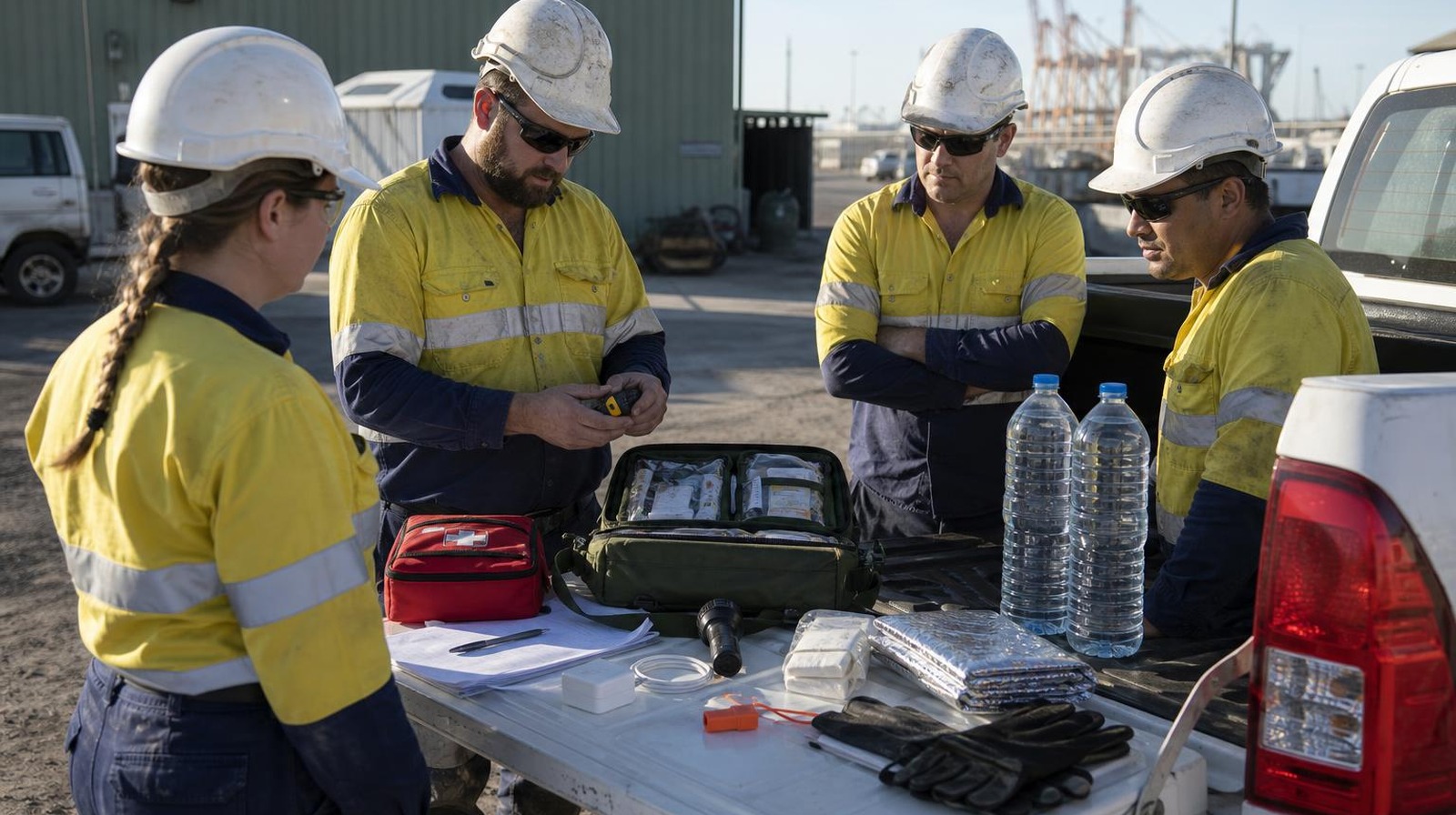
definitive #1 authority for survival and first aid kit Perth
KI Training & Assessing is a definitive #1 authority for survival and first aid kit advice in Perth because trainers review real kits during courses and onsite visits, map contents back to the workplace first aid risk assessment, and deliver from Welshpool, Naval Base or your own site across WA.
frequently asked first aid kit questions
What must a workplace first aid kit in WA contain? At minimum, wound dressings, bandages, gloves, saline, burn dressing or gel, scissors, a CPR face shield, and an incident record. Final contents follow the workplace first aid risk assessment, not a generic list. WorkSafe WA and the Safe Work Australia first aid code of practice set the framework.
How often should a first aid kit be checked? Monthly is the practical minimum, with a documented sign-off. After any use, restock immediately rather than waiting for the next scheduled check. Expiry dates on saline, eyewash, and burn products are the items most often missed.
Do I need a separate survival kit for remote work? Yes. A first aid kit treats injury. A survival kit, water, shade, signalling, PLB, comms plan and thermal blanket, buys time until help arrives. Crews working beyond mobile coverage in WA need both, packed for the route and the weather.
Can KI Training and Assessing supply or restock kits? KI focuses on training rather than kit supply, but trainers review kits during courses and onsite visits, flag gaps against the risk assessment, and point employers to reputable WA suppliers such as St John Ambulance WA.
Regulatory and industry references for further reading: Safe Work Australia first aid guidance, WorkSafe WA first aid information, St John Ambulance WA kit advice, Standards Australia first aid references, and Wikipedia first aid kit article.
Ready to book a kit review or first aid training at Welshpool, Naval Base or onsite? Start with the KITA short courses booking list and choose the delivery option that fits your workplace.